Breaking News

Latest Activities

Reviews

Showing posts with label World Food Programme. Show all posts

WFP and UN-Habitat Help Four Cities Prepare For Effects Of Climate Change


MANILA – As thousands of Filipinos in the southern region of the country struggle to recover from the destruction caused by the country’s latest extreme weather event, Typhoon Bopha, the United Nations World Food Programme (WFP) is partnering with the United Nations Human Settlements Programme (UN-Habitat) to support the Philippine government’s initiatives in building resilience to climate change.

Under the 12-month partnership “Joint WFP/UN-Habitat Initiative on Philippine Cities and Climate Change Adaptation,” the cities of Butuan, Cagayan de Oro, Davao, and Iloilo – all of which have been in the path of Typhoon Bopha – will be assessed for ecological, physical, and socio-economic risks due to climate change. Local government personnel will receive training in planning and implementing activities that will help their communities adapt to the negative effects of a changing climate.

“This partnership is very valuable to us because our city is highly vulnerable to flooding. It sits at the mouth of the Agusan River, and every time the rainy season comes, floodwaters coming from as far as the Compostela Valley pour out of the river and pose a high risk to the lives of our people who live in the riverside barangays,” says Ferdinand Amante Jr., Mayor of Butuan City.

The four cities were selected based on various criteria, including exposure to natural and climate-related hazards, such as flood, drought, and rising sea levels in coastal areas. Local government commitment to building their capacities to implement adaptation measures were also considered.

“Empowering local governments and communities to adapt to climate change is key to this joint initiative. We hope that this assistance will eventually allow for the inclusion of appropriate climate change adaptation actions in each city’s local development plan,” says WFP Philippines Country Director and Representative Stephen Anderson.

WFP will oversee the implementation of the joint initiative and lead the high-impact community adaptation projects with the local government units in each of the four cities. UN-Habitat will provide technical expertise in climate vulnerability and adaptation assessments, training for local government personnel, and climate change adaptation planning.

“UN-Habitat, together with WFP, is committed to support cities in strengthening their own capacities in participatory risk and vulnerability assessment as the basis for urban planning. Given the increasing urbanization of poverty, cities are becoming the arena where the fight for the achievement of development goals will be won or lost,” explains UN-Habitat Philippines Country Programme Manager Christopher Rollo.

The WFP/UN-Habitat partnership is a component of the larger WFP Disaster Preparedness and Response Programme which is generously supported by USAID’s Office of U.S. Foreign Disaster Assistance.

WFP is the world's largest humanitarian agency fighting hunger worldwide. Each year, on average, WFP feeds more than 90 million people in more than 70 countries.

For more information on the WFP’s work in the Philippines, visit http://www.wfp.org/philippines.
Read more ...

Australia Supports Philippine Disaster Preparedness Through WFP Rice Contingency Stock


MANILA – With the Philippines currently experiencing disastrous floods, the United Nations World Food Programme (WFP) recently received a generous grant of $AU1 million (approximately Php43.8 million) from the Australian Government to significantly boost WFP’s contingency food stocks for enhanced disaster response capacity in the Philippines.

The contribution, made through the Australian Agency for International Development (AusAID), will be used to dispatch rice to flood-affected people, augmenting the Philippine Government’s relief response.

“WFP is grateful to the Government of Australia for this generous donation. WFP is actively supporting efforts of the Government of the Philippines to prepare for and mitigate the effects of natural disasters at both national and local levels,” explained WFP Representative and Country Director Stephen Anderson.

“Learning from past emergency responses, establishing a strategic contingency stock of food to complement government efforts is both an efficient and cost-effective preparedness and response measure,” he added.

The WFP contingency food stock in the Philippines will include 200 metric tons of fortified high-energy biscuits and 1,500 tons of rice, enough to support 320,000 people for two weeks.

This contingency food stock will be distributed in direct coordination with WFP’s main government partner, the Department of Social Welfare and Development (DSWD), which is also the lead government agency for emergency food response.

“The Australian Government is providing these items to the World Food Programme so that they can be drawn upon immediately in serious situations, such as this massive flooding caused by continuous heavy rains for the past two weeks,” Australian Ambassador to the Philippines Bill Tweddell said.

“This allows Australia and WFP to support the Philippine Government to respond quickly and effectively to essential humanitarian needs following emergencies and disasters. This assistance builds on the significant support Australia has already provided to the Philippines on disaster risk management and climate change adaptation, including hazard and risk analysis, integrating disaster and climate considerations in development and land use planning, community-based disaster preparedness and providing safer settlements.”

The Australian Government is among the top donors to the World Food Programme globally and has also provided generous support for WFP’s disaster preparedness and response initiatives in the Philippines. Recently, AusAID contributed to the response to Tropical Storm Washi (Sendong) by providing food and cash assistance to support emergency relief and early recovery activities.

About WFP

WFP is the world's largest humanitarian agency fighting hunger worldwide. Each year, on average, WFP feeds more than 90 million people in more than 70 countries.

WFP now provides RSS feeds to help journalists keep up with the latest press releases, videos and photos as they are published on WFP.org. For more details see: http://www.wfp.org/rss.

Twitter: @wfp_asia and @wfp_philippines and @wfp_media
Facebook: WFP Philippines

About Australian AID

The Australian Agency for International Development (AusAID) is the Australian Government agency responsible for managing Australia's overseas aid program. The fundamental purpose of Australian aid is to help people overcome poverty.
Read more ...

WFP Supports Government Relief Efforts For Flood-Affected Communities


MANILA – In the wake of monsoon rains that have brought severe floods to the Luzon and Visayas regions, the United Nations World Food Programme (WFP) has mobilized logistics and food support tocomplement the Philippine Government’s emergency relief efforts, working closely with the Department of Social Welfare and Development (DSWD).

“WFP is saddened by the humanitarian impact of the non-stop rains over the last week in the Philippines, and we would like reiterate our solidarity with the Philippine Government during times of emergencies. We stand ready to offer our full support to augment government efforts when needed,” said WFP Philippines Representative and Country Director Stephen Anderson.

WFP has delivered a total of 52.5 metric tons of high-energy biscuits to benefit 262,500 flood-affected individuals from the National Capital Region, Region III, and Region IV-A. These biscuits are currently being distributed by the DSWD.

Most of the biscuits (39.5 metric tons) will go to Regions III and IV-A, which the government has identified as the most flood-affected, where they will be distributed to 197,500 people.

The remaining 13 metric tons will assist 65,000 flood-affected people in the National Capital Region, which includes the areas of Manila, Marikina, Muntinlupa, Paranaque and Quezon City.

High-energy biscuits are wheat-based biscuits fortified with vitamins and minerals. They are often distributed during the first few days of an emergency, when people have limited access to cooking facilities.

In addition to distributing the biscuits, WFP is contracting trucks to help transport DSWD relief supplies to affected communities in Metro Manila and neighbouring provinces.

In the coming days, WFP will also distribute nutritious ready-to-use supplementary food to about77,000 flood-affected children (aged 6 to 36 months) in Luzon, in partnership with the Department of Health.

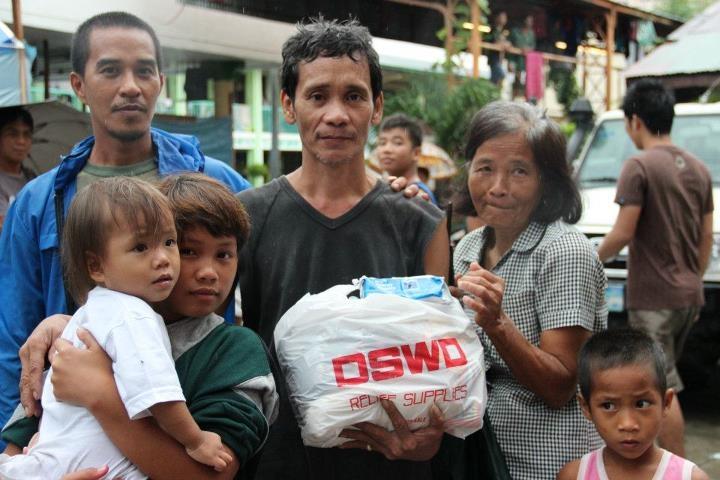
A family in Tunasan Elementary School in Muntinlupa City receives their
DSWD relief pack, which includes WFP high-energy biscuits.
About WFP

WFP is the world's largest humanitarian agency fighting hunger worldwide. Each year, on average, WFP feeds more than 90 million people in more than 70 countries.

WFP now provides RSS feeds to help journalists keep up with the latest press releases, videos and photos as they are published on WFP.org. For more details see: http://www.wfp.org/rss.

Twitter: @wfp_asia and @wfp_philippines and @wfp_media
Facebook: WFP Philippines
Read more ...

Spain Supports Fight against Hunger in the Philippines


Her Majesty Queen Sofia of the Kingdom of Spain (leftmost) listens intently as Philippine Department of Social Welfare and Development (DSWD) Secretary Corazon Juliano-Soliman (third from right) and United Nations World Food Programme (WFP) Deputy Country Director Asaka Nyangara (rightmost) jointly brief her regarding emergency relief and rehabilitation activities mounted in response to Tropical Storm Sendong. The presentation was made during Queen Sofia’s visit to the Climate Change Academy in Bicol province earlier this month. With Queen Sofia was Spanish Secretary of State for International Cooperation Jesus Gracia (third from left).

The Kingdom of Spain, through its Agencia Española de Cooperación Internacional para el Desarrollo (AECID) or Spanish Agency for International Development Cooperation, is a major donor to the Philippines and strongly supports the fight against hunger and malnutrition in the country. Since 2009, Spain has given over USD4.5 million (Php190.6 million) to support various WFP programmes, implemented in close partnership with DSWD, that help ensure proper nourishment for children and pregnant and lactating women who have been displaced by conflict in Mindanao, as well as for relief and rehabilitation of communities affected by natural disasters.

Photo Credit: WFP/Mei Nebreja/Philippines
WFP is the world's largest humanitarian agency fighting hunger worldwide. Each year, on average, WFP feeds more than 90 million people in more than 70 countries.

WFP now provides RSS feeds to help journalists keep up with the latest press releases, videos and photos as they are published on WFP.org. For more details see: http://www.wfp.org/rss

Twitter: @wfp_asia and @wfp_philippines and @wfp_media
Facebook: WFP Philippines

For more information please contact:
Charlene Tordesillas, WFP/Manila, Tel: +63 2 7502561 Mobile: +639178809368
Email Address: charlene.tordesillas@wfp.org
Read more ...

US Government Scales up Support for WFP Disaster Preparedness in the Philippines


PRESS RELEASE

Manila, Philippines – The United Nations World Food Programme (WFP) received a US$3.75 million (approximately Php 160 million) grant from the United States Agency for International Development (USAID), which will be used to expand WFP’s disaster preparedness and response programme in the Philippines.

Working in close partnership with the central government and the Office of Civil Defense, WFP and local government units in four disaster-prone provinces of Sorsogon, Benguet, Cagayan and Laguna have been rolling out a disaster preparedness and response pilot programme focused on building local emergency management capacity, disaster mitigation and protection of livelihoods.

"The Philippines was among the world’s most disaster-affected countries in 2011 and WFP is doing its utmost to build resilience among vulnerable communities to allow them to better cope with natural disasters," said WFP Philippines Representative and Country Director Stephen Anderson. "WFP is grateful to the U.S. government for its support, which builds on the successful results achieved by national and local governments over the past year."

The new funding from USAID will enable WFP to expand its disaster preparedness activities to parts of the Visayas (Iloilo) and Mindanao (Cagayan de Oro, Butuan and Davao), and to engage local non-government organizations and universities in efforts to build resilience to natural disasters, increasingly exacerbated by climate change.

The key components of this expanded initiative will include community-driven disaster mitigation and preparedness projects such as flood control and landslide mitigation activities, training for disaster management personnel tailored to local needs such as contingency planning, and the promotion of innovative and cost-effective disaster mitigation and climate change adaptation projects such as early warning techniques.

This latest contribution from USAID brings the cumulative total of U.S. funding support for WFP’s disaster preparedness and response programme in the Philippines to US$4.5 million. As with the pilot phase, complementary matching resources from the national government and local government will be sought to reinforce the programme’s sustainability.

# # #

About WFP

WFP is the world's largest humanitarian agency fighting hunger worldwide. Each year, on average, WFP feeds more than 90 million people in more than 70 countries.

WFP now provides RSS feeds to help journalists keep up with the latest press releases, videos and photos as they are published on WFP.org. For more details see: http://www.wfp.org/rss.

Twitter: @wfp_asia and @wfp_philippines and @wfp_media
Facebook: WFP Philippines

About USAID

For 50 years the United States, through USAID, has been a key partner of the Philippines in addressing the humanitarian needs of Filipinos in times of disaster. The United States was among the countries that took an active role in contributing to recovery efforts following Typhoons Reming and Milenyo in 2006, Frank in 2008, Tropical Storm Ondoy in 2009, Typhoon Juan and Tropical Storms Pepeng and Santi in 2010, and Sendong in 2011. For more information, visit http://philippines.usaid.gov.

For more information, please contact:

World Food Programme - Philippines (Email: charlene.tordesillas@wfp.org):
Charlene Tordesillas, WFP/Manila, Tel: +63 2 7502561 Mobile: +639178809368
Read more ...

WFP Partners With DSWD

WFP supports DSWD in Strengthening Logistics Information System for Disaster Response Preparedness

WFP MOA signing with DSWD
Philippine Department of Social Welfare and Development (DSWD) Secretary Corazon Juliano-Soliman and World Food Programme (WFP) Philippines Country Director and Representative Stephen Anderson recently signed a Memorandum of Agreement to strengthen the DSWD’s disaster response capacity. The partnership, funded by the USAID/Office for Foreign Disaster Assistance, aims to use information and communication technologies to improve logistics information flow within DSWD, which will be of particular relevance in the immediate aftermath of natural disasters, providing the Philippine Government with timely and accurate information that will allow for swifter emergency responses. WFP National Ambassador Against Hunger KC Concepcion witnessed the signing.

With the presence of WFP Nat'l Ambassador KC Concepcion
Photo Credits: WFP/Philipp Herzog/Philippines

WFP is the world's largest humanitarian agency fighting hunger worldwide. Each year, on average, WFP feeds more than 90 million people in more than 70 countries.

Follow WFP on Twitter: @wfp_asia and @wfp_philippines and @wfp_media
Read more ...

WFP Supports the Government Response to Sendong-affected Communities


Tropical Storm Washi (locally known as “Sendong”) which hit Northern Mindanao over the weekend, caused massive flooding, flashfloods and landslides, resulting in the death of over 1,000 people. Some 285,000 people have been displaced, many of whom are taking refuge with relatives or in makeshift structures. The World Food Programme (WFP) is responding to the Philippine Government’s request for international support and is mobilizing to assist 220,000 of the most vulnerble persons, many of whom have limited access to nutritious food and clean drinking water. Augmenting government’s relief efforts, WFP assistance, at the initial phase of the response, focuses on providing fortified ready-to-eat foods as well as logistics support to the Philippine government and humanitarian agencies.

Photo credit: WFP/John Javellana/Philippines
World Food Programme/Philippines’ National Ambassador Against Hunger, KC Concepcion, and WFP Country Director and Representative, Stephen Anderson visit communities affected by Tropical Storm Washi in Cagayan de Oro City. WFP, in partnership with the Philippine Department of Social Welfare and Development, is distributing fortified ready-to-eat food to highly affected families in evacuation centers.

# # #

WFP is the world's largest humanitarian agency fighting hunger worldwide. Each year, on average, WFP feeds more than 90 million people in more than 70 countries.

WFP now provides RSS feeds to help journalists keep up with the latest press releases, videos and photos as they are published on WFP.org. For more details see: http://www.wfp.org/rss

WFP has a dedicated ISDN line in Italy for quality two-way interviews with WFP officials.

For more information please contact Mei Nebreja at
Mei.Nebreja@wfp.org, Tel. : +63 2 750 2561 local 2430, Mobile: +63 917 5713 162
Read more ...

WFP Disaster Preparedness and Response


WFP News Release
24 October 2011

MANILA – A US$750,000 cash grant from the United States Agency for International Development/Office of Foreign Disaster Assistance (USAID/OFDA) is powering the United Nations World Food Programme’s (WFP) Disaster Preparedness and Response project in four of the most disaster-prone provinces of Northern Luzon.

WFP’s 12-month project in Benguet, Cagayan, Laguna and Sorsogon, which is already up and running, is being implemented in collaboration with the Department of Social Welfare and Development (DSWD), the Department of the Interior and Local Government (DILG), the Office of Civil Defense (OCD) and WFP’s local NGO partner the Philippine Business for Social Progress (PBSP).

“WFP highly appreciates USAID/OFDA’s timely and generous funding for a key government priority. This support is critically needed for a country which is so vulnerable to natural disasters,” said WFP Philippines Country Director Stephen Anderson. “The recent floods and the damage to agriculture caused by Typhoons Pedring and Quiel have highlighted once again how essential it is for us to work together to improve disaster preparedness and response.

“Fundamental to the success and sustainability of this project is the strong partnership with DSWD, DILG, OCD and the Local Government Units (LGUs) which have committed to implement small-scale community projects to help mitigate the impact of disasters,” said Anderson.

The participating LGUs have earmarked 13.9 million pesos in counterpart funds for the projects, while DSWD is providing 3.9 million pesos from its Disaster Fund.

A Capacity Needs Assessment on Disaster Preparedness and Response that WFP conducted together with the Earthquakes and Megacities Initiative highlighted the need to mitigate the impact of landslides in Benguet, to improve flood control systems in Cagayan and Laguna and to strengthen the capability of communities in Sorsogon to better respond to volcanic eruptions and flooding. The study findings are consistent with WFP’s experience of carrying out small-scale, community-driven early recovery and rehabilitation activities in partnership with DSWD in the aftermath of Tropical Storm Ondoy and Typhoon Pepeng in late 2009 and 2010.
# # #

WFP is the world's largest humanitarian agency fighting hunger worldwide. Each year, on average, WFP feeds more than 90 million people in more than 70 countries.

WFP now provides RSS feeds to help journalists keep up with the latest press releases, videos and photos as they are published on WFP.org. For more details see: http://www.wfp.org/rss.

Follow us on Twitter @wfp_media.

WFP has a dedicated ISDN line in Italy for quality two-way interviews with WFP officials.

For more information please contact (Email Address: angeli.mendoza@wfp.org):
Angeli Mendoza, WFP/Manila, Tel: +63 2 7502561 Mobile: +63 917 8809368
Read more ...

Enter your e-mail to receive updates from RunningAtom

Subscribe to RunningAtom

Fitness

Health

The Other Side of my Cerebro

Poetry

Short Story

Technology

Contact Form

Name

Email *

Message *

Designed By Blogger Templates